
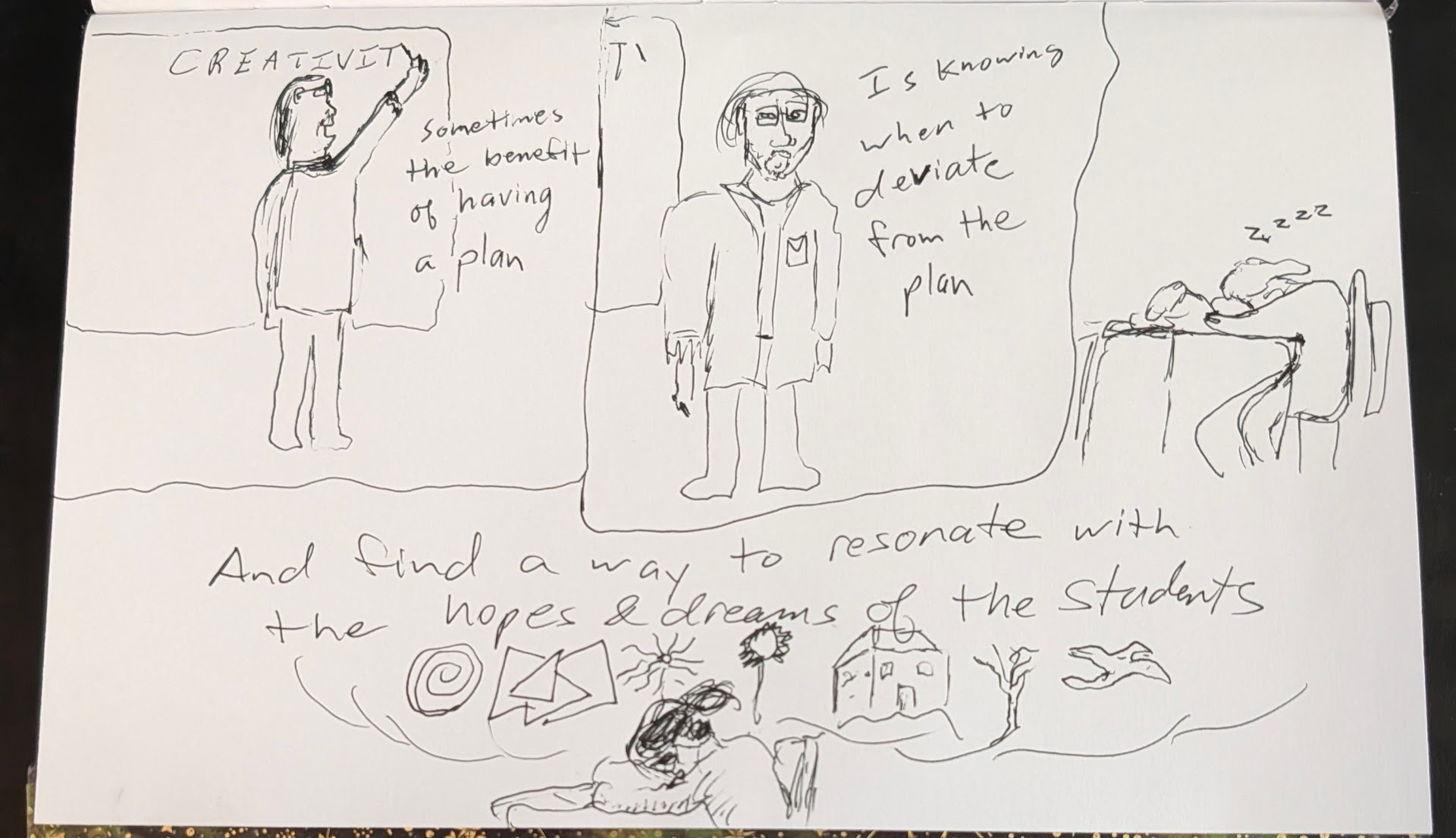

It’s good to have a solid plan, but it’s also good to recognize off-ramps for opportunity. Well-worn clichés: we knock them, but there’s a reason they’re so lived-in. They work. We run into problems when we let them do the thinking for us, but if used mindfully, they’re symbolic keys to emotional locks. If you fail to plan, you plan to fail. I love it when a plan comes together. We plan while God laughs. The well-laid plans of mice and men… And while plans are important, they can be constraining. How does one reap the benefits of a plan while embracing the freedom of spontaneity?
The education industry fetishizes many of the mundane aspects of the job in the name of “accountability.” Bulletin boards — the New York City Department of Education™ has a bizarre fascination with a well-made bulletin board. I’ve often quipped that a teacher can play a recording of himself singing Green Eggs and Ham to the tune of “Holy Diver” by Dio on a loop inside the classroom and still be deemed a master if his bulletin board outside the classroom checks the correct boxes on a clipboard-bound rubric.
Enter The Lesson Plan. The bureaucratic scourge of the natural pedagogue. There’s a reason for lesson plans. As stated above, it is good to have a plan. How do you get anywhere if you don’t know where you’re going? I guess that’s how you get “anywhere.” But the whole point of education is to get somewhere. But where?
The plan is like a map. It tells us where we’re going and how to get there. But sometimes the students — remember the students? They’re riding this bus too — need to adjust the itinerary.
Because we need structure. Imagine your body without a skeleton. The only humans I’ve ever seen function without a proper backbone are in Congress. Structure creates boundaries, shows me where I end and everything else begins, helps me discern what is important from what is unimportant. But structure can become a crutch. A crutch provides support when the true structure cannot bear the weight. It is a temporary tool to aid the repair of infrastructure. But crutches are superfluous and limiting when the underlying structure is sound.
This is where the exits come in. When I was a boy, I took many a road trip with my dad. I would be on a vigilant lookout for those blue highway signs denoting rest stops — “DAD, THEY HAVE PIZZA HUT! CAN WE GO?” More times than not, Dad, who held the plan in his head, would read the room (car) and take the exit — because suddenly food and relief are more practical than the destination hundreds of miles and many hours ahead.
There’s comfort in a good lesson plan. But I’m the type of teacher who finds those off-ramps, throws the blinker on, and makes the merge. Because I live a life of structured fluidity.
Structured fluidity is the hallmark of my AuDHD mind. With no structure, I’m a boneless chicken, a gelatinous being, Speaker of the House. But with too much structure, I’m Hannibal Lecter on a hand truck. I live in the gray area. That gray area can be the bane of my existence, but like most challenging fields, there’s treasure buried in the muck. The gray area is where life happens.
It’s a reframing of the famous Serenity Prayer:
God, grant me the serenity to accept the structures I cannot change, the courage to take the exits I can, and the wisdom to know the difference.

Aye, there’s the rub. Wisdom is gray. I see The Hermit image from the tarot. My hair is turning more Obi-Wan than Luke. The gray is lovely, dark, and deep; one can drown. But the treasures… wisdom is rewarded. The difference is exponential.
The wisdom is in one of those treasure chests gleaming in the gray.
Leave a Reply